
Asking for reviews can feel awkward. But it doesn’t have to be.
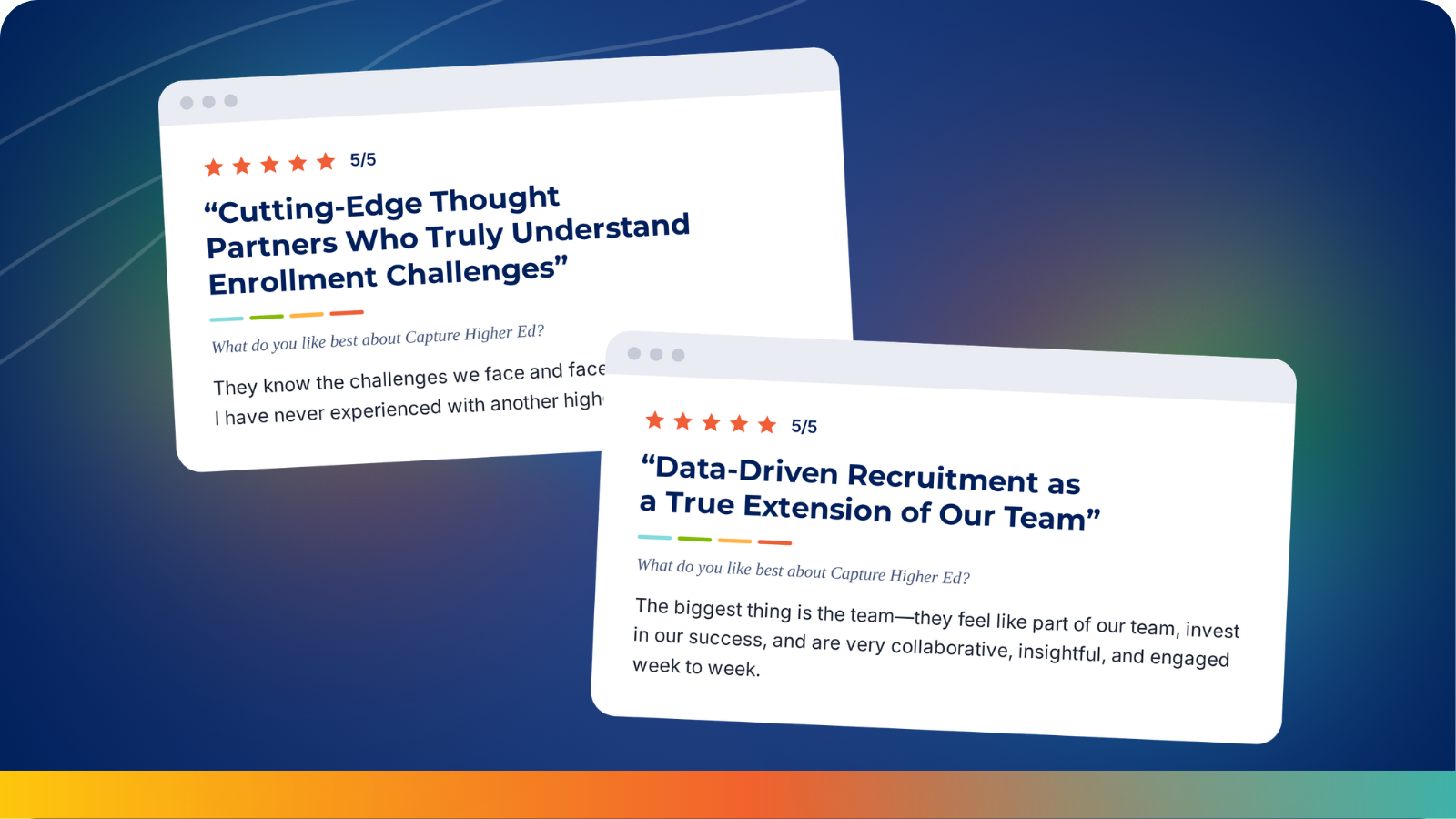
Right now, our team is reaching out to our partners and asking them to leave a review of Capture on G2 – a site where people review the software they use at work. It’s a simple request, but it still feels a little uncomfortable every time we ask.
We’re doing it anyway, because the way people research has changed. When an enrollment leader asks ChatGPT or Gemini which platforms can identify anonymous website visitors, the AI builds its answer from everything it can find across the web. What our partners say about us carries far more weight in that answer than anything we say about ourselves.
Your prospective students are doing the same thing with your college. If we’re going to ask our partners to go out on a limb for us, it felt fair to explain why reviews matter so much for AI search and how your team can start collecting them from the people who know your campus best.
When I sat on your side of the desk, I asked students to leave reviews for the institution I worked for, so I picked up a few tips along the way to make it feel less weird.
Why do online reviews matter for AI search?
AI tools build their answers from sources they trust, and independent voices like reviews, forums, and directories show up in those answers far more often than a brand’s own website does.
From our research, 47% of high school juniors and seniors said they already use AI during their college search, and 81% of those students use tools like ChatGPT and Gemini. They lean on AI to find colleges that match their interests, compare programs, and get quick answers about admission requirements.
When a student asks one of those tools for small colleges with a strong nursing program, the model goes looking for sources that sound credible and independent. An Omniscient Digital analysis of more than 23,000 AI citations found that 57% of citations on brand-specific questions pointed to reviews, listicles, forums, social media, and case studies.
Where do AI tools find reviews about colleges?
For most colleges, the reviews that matter live in a few places: Niche, Google, and Reddit. Each one plays a different role, and you can only easily ask for reviews on two of them.
Niche holds nearly 500,000 student reviews, the largest collection of college reviews online. Students research there directly, and AI tools pull from it when they describe what campus life is like. This is where current students and recent alumni can make the biggest difference, so it’s the first place to point them.
Google Business Profile shows up in Maps, local results, and AI Overviews whenever a family searches your name. Reviews here tend to come from visitors and parents, and sometimes students. Ask for them, reply to every one, and keep your hours, address, and photos current so the rest of the profile backs up what reviewers say.
Reddit works differently. It’s among the most-cited domains in several AI citation studies, and threads in r/ApplyingToCollege and r/college shape what AI says about your school. You can’t ask for reviews there, and inauthentic posts tend to get called out quickly. Your job on Reddit is to monitor what’s being said and politely correct factual errors with a source.
The risk of doing nothing is real. If your most recent reviews are from 2021, or if the loudest voice about your campus is one frustrated Reddit thread, that’s the material AI has to work with. Profound’s analysis of more than 4 billion AI citations found AI tools cite positive and negative Reddit posts about a brand at nearly the same rate, so a critical thread is just as likely to surface as a glowing one. A steady flow of recent, genuine reviews gives the model a fuller picture.
How can a college get more online reviews?
Start with the students who already tell your story every day, then make the ask easy for them.
1. Find out where you stand
Look up your institution on Niche and Google and write down three things for each: how many reviews you have, your average rating, and the date of your most recent review. Then open ChatGPT, Gemini, and Perplexity and ask, “What do students say about [School]?” and note which sources each tool cites. That list tells you where your reputation is being built right now.
2. Recruit your tour guides first
Your tour guides, student ambassadors, and orientation leaders are the easiest place to begin. They already love your campus enough to talk about it for an hour at a time, and they answer the same questions prospective students are typing into AI tools. Recent alumni and student workers in admissions are a strong second group.
3. Ask for honest reviews
Ask students to share what’s true for them, including the things they’d change. The ask also lands better coming from someone they already know, like their tour coordinator, work supervisor, or a staff member they’re close to. A note from a familiar name is much harder to ignore than one from a general admissions inbox or the marketing team. Keep a few rules in place:
- No scripts or pre-written reviews for students to copy
- Invite a wide group of students, not only the ones you know will rave
- No swag, gift cards, or perks in exchange for Google reviews, since Google’s policies prohibit incentivized reviews
4. Time the ask around high points
Students write better reviews when they’re feeling connected to campus. End of the fall semester, right after a big tradition like homecoming, and the last few weeks before graduation all work well. For tour guides, the week after a busy and exciting open house is also a natural moment when momentum feels high.
5. Reply, monitor, and repeat
Reply to your Google reviews, including the critical ones, with a thank you and a clear next step. Rerun your AI prompts from step one each semester to see whether new reviews are showing up in the answers. Then send the ask again to a new group of students so the flow of reviews stays steady.
Email Template: Asking Tour Guides For a Review
We created this email template that you can copy, update, and send from someone your tour guides know personally, like your tour coordinator or director of admissions. This should give you a good starting point to make your own. Don’t forget to link directly to your Niche profile!
Subject Line Options:
A small favor from the Admissions Office
You already tell our story. Want to share it?
Email:
Hi [First Name],
Every week you tour families around campus and answer the questions they’re too nervous to ask anyone else. You’re a big part of why students end up choosing [Your Institution].
I have a small request. Would you be willing to leave a review of your experience at [Your Institution] on Niche? It takes just a few minutes, and it helps future students hear from someone who actually goes here. Leave your review here.
A few notes before you start:
– Write about what’s true for you. The highlights and the things you’d change are both helpful.
– Specific details go a long way: a favorite class, a professor who made a difference, or the moment that campus started to feel like home.
– This is completely optional, but we’d appreciate your help!Thank you for everything you do for our visitors and future students!
[Your Name]
[Title]
[Your Institution]
The final word
Reviews help students find you and trust you before they ever reach out. In our report, 53% of students applied or requested information without ever directly interacting with a college first. Much of that research happens quietly, in AI tools, on Niche, and on your website, long before anyone fills out a form.
Once those students land on your site, Capture’s Stealth ID shows you who they are and what they’re interested in, so your team can reach out while interest is high. Start here to see what a Capture partnership could look like.
Frequently asked questions
Do online reviews affect AI search results?
Yes. AI tools like ChatGPT, Gemini, and Perplexity pull heavily from third-party sources, including review sites and forums, when they answer questions about a college. Recent, genuine reviews give those tools accurate material to draw from.
Which review sites matter most for colleges?
Niche and Google Business Profile are the two platforms colleges can actively build. Reddit also shapes AI answers, but colleges should monitor it and correct errors rather than solicit reviews there.
Can colleges ask students to leave reviews?
Yes, as long as the ask is for an honest review. Google’s policies prohibit offering incentives for reviews, so skip the swag and perks there. Colleges should check each platform’s guidelines before sending an ask, since there may be rules on incentives and employee reviews.
How many reviews does a college need?
There’s no set number. A steady flow of recent reviews matters more than a single big push, which can look manufactured to both AI platforms and readers.
How can I see what AI tools say about my college?
Ask ChatGPT, Gemini, and Perplexity questions a prospective student would ask, like “What do students say about [My Institution]?” Note which sources they cite, and repeat the check every semester.