

A student visits your website three times this month. She reads about your nursing program, checks the cost calculator twice, and clicks on a page about clinical placements. Then she gets an email from you that says “Discover Your Future” with a list of program offerings, which does include nursing, but it’s buried several scrolls down.
She doesn’t reply. She doesn’t complain. She just quietly moves on.
Our latest 2026 Student Enrollment Expectations Report shows exactly how often this happens, and what’s changed in student expectations and behavior that makes it more costly than ever.
What counts as personalized outreach to a student?
Personalized outreach doesn’t have to be a sophisticated automation or (worse) an AI-drafted note that guesses at a student’s name and major. For prospective students, personalization is simply evidence that someone paid attention to what they’ve already shown interest in, with the biggest indicators being a reference to their major or financial aid needs. Emails themselves can come from a person, or your university itself.
According to the latest data, 88% of students prefer when a message is written by a person, and 31% of students started an application after receiving just one correctly personalized message.
How many students are you leaving behind by sending them all the exact same message?
Generic outreach reads as AI, even when a human wrote it.
Students no longer give mass outreach the benefit of the doubt. Most now assume a message is AI-generated by default: 60% of students believe half or more of the college messages they receive are AI-written. That means if AI-generated is the default, the only thing that stands out is human-in-the-loop personalization.
Even when you’re not using AI to write content, generic messages written entirely by a human still trip that same reaction. Cookie-cutter messages are reading as AI, whether you had a machine write it or a person typed it into a template.
57% of students say they’re less likely to apply to a college they know uses AI agents to contact students, and most say they’d rather hear from the college whose message clearly came from a person.
The penalty for generic outreach is attached to the message, which means personalized outreach is no longer optional; it’s the only thing that reads as human at all.
How do you actually personalize outreach at scale with a lean team?
Personalizing outreach doesn’t require a full rebuild of all your enrollment marketing. You can start with a few meaningful messages and slowly work it into your on-going strategy:
1. Segment your next send by major before you hit send.
93% of students say referencing their intended major makes a message feel personalized, and 70% say the same about financial aid, so these are the two clearest signals to start with.
If you’re already collecting intended major anywhere, an application, a test score send, a landing page form, use it to split your next campaign into a handful of major-specific versions instead of one message for the whole list. You could even bucket your majors by topic (e.g. STEM, Arts, Humanities, etc.) to help get you started.
2. Set up triggered emails tied to specific website pages.
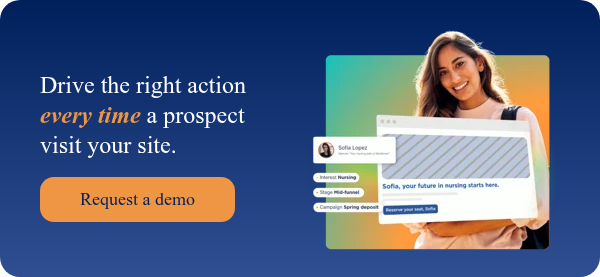
When a known student visits a program page, financial aid page, or another high-intent page on your site, follow up within 24 hours with content specific to what they looked at— outside of your standard nurture sequence.
Capture’s Email Marketing services build exactly this kind of behavior-driven sequence: campaigns triggered by real-time student activity instead of a static send schedule, crafted by strategists who nurture students from first touch through enrollment based on what they actually did, not a demographic guess.
3. Check what a student has done before you reach out.
Before a counselor picks up the phone or sends an email, a quick look at recent website and email activity turns a cold call into a warm one. Ensure counselors are tailoring their conversations based on what that student cares about.
Capture’s Counselor Copilot uses behavioral data to draft individualized messages for the students most worth reaching out to right now, with a counselor reviewing and editing before anything sends, so personalization scales without losing the human review students say they want.
4. Let behavioral data decide who gets a message today, not next week.
With a small and busy team, the biggest constraint usually isn’t knowing what to say, it’s knowing who to say it to first. Prioritizing outreach by actual engagement, rather than by whoever’s next on an alphabetical list, makes a small team’s time go a lot further.
Capture’s Daily Visitor Report delivers exactly this to counselors every morning: which students visited the site in the last 24 to 48 hours and what they looked at, so outreach can reference something real instead of opening blind.
Key takeaways
- One genuinely personalized message drives real action: 31% apply after receiving it.
- Generic messaging reads as AI-written regardless of who actually wrote it.
- Major and financial aid interest are the two signals students most want reflected in personalized outreach.
- None of this requires a big team. Triggered emails, a quick CRM check before outreach, major-based segmentation, and behavior-based prioritization are all achievable with lean resources.
Frequently asked questions
What is personalized outreach in college admissions?
Personalized outreach is communication that reflects a specific student’s demonstrated interests, like their intended major or financial aid needs, rather than generic messaging sent to an entire list.
Does personalized outreach mean we can’t use AI at all?
No, AI-drafted outreach that reflects real behavioral data can work. A well-formatted but generic message fails the same test a generic human email does. You’ll want to keep a human in the loop at all times when using AI. You should review and edit all AI-generated content prior to sending.
What’s the fastest way to start personalizing outreach with a small team?
Segment your next send by intended major using data you already have, and build one triggered email tied to your most-visited program page. Both require no new tools to start.
How do we know what to personalize before a student tells us?
Their behavior. Program pages visited, time spent on financial aid content, and repeat visits all signal intent long before a form gets filled out. Behavioral intelligence platforms exist specifically to track and score these patterns for exactly this purpose.