

When I worked on the campus side, there were weeks when I’d write a dozen emails before lunch. A travel-season reminder, a deadline push, an open house invite, and whatever else the team needed out the door by the end of the week. I cared about every one of them. But I also pulled up last year’s version of the same email, updated the dates, and hit send more times than I’d like to admit.
None of those emails were written by AI. Generative AI was taking off fast during my last few years on campus, but every one of them came from a real person on our team. They could definitely come across as generic, though. If a high school senior read them today, I’m pretty sure a lot of them would get flagged as AI anyway.
That’s one of the more alarming findings in our new Student Enrollment Expectations Report. We asked nearly 6,000 students what makes a college message feel AI-generated, and their answers had very little to do with who (or what) actually wrote it. What they’re really reacting to is whether a message sounds like it could have come from anyone.
Students assume a robot wrote it
According to the Student Enrollment Expectations Report, 60% of students believe half or more of the college emails and texts they receive are written mostly by AI. About a third say most of them are. Only 2% say never.
That means your email gets opened by someone who already suspects it was AI-generated, and they read it looking for proof. For some students, the verdict comes before the email is even opened. In thousands of open-ended responses, respondents said things like:
“I can usually tell when I receive generic emails by the subject line and ignore them.”
The tells students look for show up in human-written copy all the time. A generic message written entirely by a person still can read as AI, and it pays the same price.
What sounding like AI costs you
Students don’t need proof that a machine wrote your email. 55% say their view of a college becomes more negative when a message just feels AI-generated.
The penalty gets steeper when students can tell AI is doing the talking. When a college is clearly using an AI agent to reach them, 31% lose interest in the college, 21% ignore it, and 8% unsubscribe or block. When we showed students the same message from two different colleges, one written by a person and one by AI, 88% said they would rather hear from the college whose message was written by a person. And 57% say knowing a college uses AI agents to contact students makes them less likely to apply.
Students also hold machines to a higher standard. A wrong detail bothers 31% of students more when AI wrote it, compared to 25% when a person did. In their written responses, students connected lazy emails to what they could expect from the college itself:
“If they won’t even put in the effort to actually write an email, why would I think they would put effort into actually assisting me?”
The flip side is encouraging. When a college personalized a message correctly, 94% of students did something about it. 57% visited the college’s website again, 29% attended an event or visit, and 31% started or submitted an application. That’s a lot of movement from a single email.
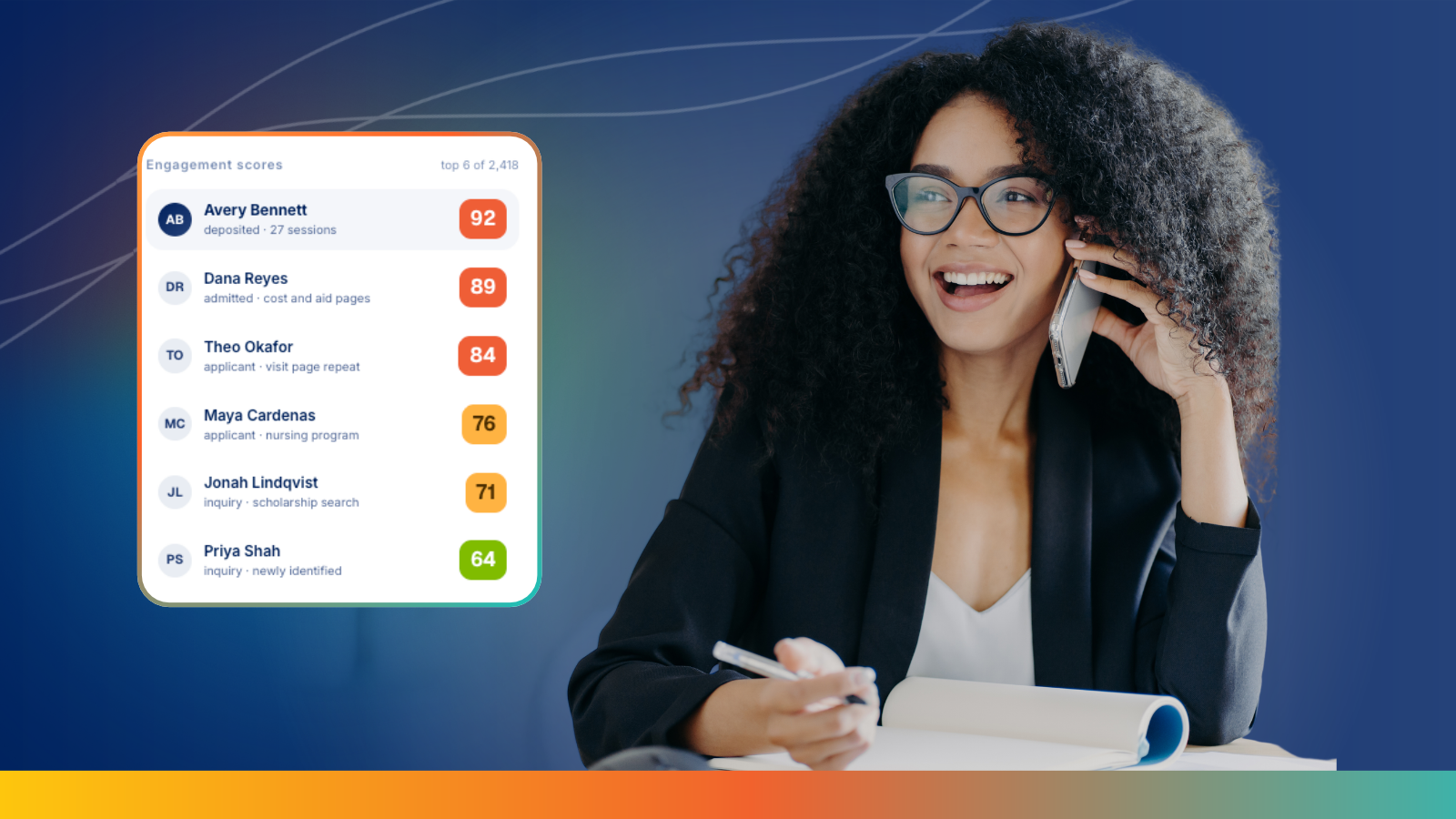
Capture’s Priority Scores rank students by engagement and affinity, so your team knows which students should get that kind of personal outreach first.
The AI tells, according to students
We asked students what makes them think a college message was AI-generated. Only 9% said they usually can’t tell. Here’s what the rest are watching for and what to do about each one.
1. Generic or vague wording (57%)
This is the top tell by a clear margin. Think “a vibrant campus community,” “we can’t wait to see where your journey takes you,” or “explore everything we have to offer.” None of those lines are wrong. They just don’t tell a student anything specific about your institution. And since any college in the country could describe itself the same way, they won’t help you stand out anyway.
You should get to know your college’s voice inside and out. Sit down with the people you’re writing on behalf of, like faculty, coaches, and current students, and listen to how they talk about the place. Then write the way they talk.
And show students what makes your community special instead of telling them. Rather than calling your campus vibrant, describe the tradition everyone shows up for, like the midnight pancake breakfast the night before finals.
Students told us exactly where to start: 95% expect a college to personalize around their intended major, and 83% expect it around financial aid and scholarships.
This is where Capture’s Stealth ID and Student 360 Profiles come in handy. They show which programs and pages a student has explored, even before they fill out a form, so your very first email can lead with their intended major. You don’t have to wait for a student to raise their hand and tell you what they’re interested in. Their behavior on your site is already telling you, and Capture puts it right in front of your team.
2. Sounds identical to what other colleges send (54%)
A third of students get more than 30 college emails a month, and yours gets read right alongside all of them. When the subject lines, stock photos, and “you’d be a great fit” language all match, every college starts to blur together. One student said:
“They all sound the same no matter where they are coming from, which is why I don’t bother reading many of them.”
Sometimes that sameness is thanks to long-time legacy vendors running the same generic playbook across every institution they work with, without knowing what makes each institution different.
Try covering your logo and rereading the email. If a competitor could send it without changing a word, rewrite the parts only your institution could say. Then check for sameness inside your own comm flow, since nearly half of students said getting information they’ve already received is the personalization mistake that bothers them most.
3. Overly polished or formal (44%)
Copy that’s been through three rounds of approvals often ends up sounding like a press release. Students read that smoothness as a machine.
Read your message out loud. If it doesn’t sound like something your best counselor would say to a student at a college fair, loosen it up a bit. Contractions and short sentences are your friends.
4. Weird or over-the-top enthusiasm (42%)
Three exclamation points and “We’re SO excited for you!” lands strangely when a student hasn’t even applied yet or hasn’t heard from you before.
You should match the energy to the relationship. Save the big celebration for the admit letter and keep early outreach warm and specific.
5. Doesn’t answer my actual question (35%)
A student asks about transfer credits and gets back a general overview of admissions. It doesn’t matter who wrote that reply — it reads as AI-generated.
You should answer the question in the first line, then add context. If an autoreply is the only thing standing between a student’s question and your team, make sure it routes them to a real person quickly.
Capture’s Counselor Copilot helps here by giving counselors a daily priority list with each student’s behavioral history, so they know the context behind a question before they reply. Copilot can also draft the email, text, or phone script, but a counselor reviews and edits before anything gets sent.
6. Formatting cues like em dashes and emojis (27%)
Here’s some good news if you’ve been searching your drafts for em dashes: formatting came in sixth. 27% of students pointed to formatting, which is less than half the share who flagged generic wording. So go ahead and keep your em dashes.
You definitely shouldn’t go overboard with the em dashes, but don’t overthink your punctuation. Adjusting your wording to sound more human will do far more than fixing the dashes.
7. Too long (16%)
Length came in last. Students will read a longer email if it’s relevant to them.
You should cut filler before you cut substance. A long email full of specifics beats a short one that says nothing.
Two personalization mistakes that also read as AI-generated
Personalization can backfire when it’s done badly. A broken merge field like “Dear [First Name]” bothers 47% of students, which ties it with the worst personalization mistakes on the list. And 32% are bothered when a college acts like it knows them when it clearly doesn’t.
Be careful about telling students what you know, too. Use what you know to decide what a student sees and skip the “we noticed you visited our nursing page” line. Just send them a great email about nursing instead.
Capture’s Behavioral Emails and Dynamic Pages are built to work this way. They use what students do on your site to decide what content they see and when, so students get the nursing email without the “we noticed” line.
Start with your last ten sends
Pull the last ten emails your team sent to prospective students and read them against the list above. Mark every vague line, every sentence a competitor could send, and every reply that didn’t answer the question. That short exercise will tell you more about how students are reading your outreach than any online AI detector.
The Student Enrollment Expectations Report goes deeper into what students expect from college outreach, including where they want AI involved and where they don’t.
Most enrollment teams already know how to write a good email. What they’re usually short on is time and information about who’s on the other end.
Capture has used AI since 2014, and almost all of it runs in the background. It figures out who a student is and what they care about so your team can write to them like a person would. Plus, a human stays in the loop the entire way. Capture never sends an AI-generated email on your behalf without someone on your team reviewing and editing it first. Students told us that’s exactly where they want AI to be.
And if you’d like help figuring out which students should get your team’s most personal outreach and what it should say, we’d love to show you what a Capture partnership could look like.